Before the Drum Turns: The Five-Minute Button MOT Every Cardigan Deserves
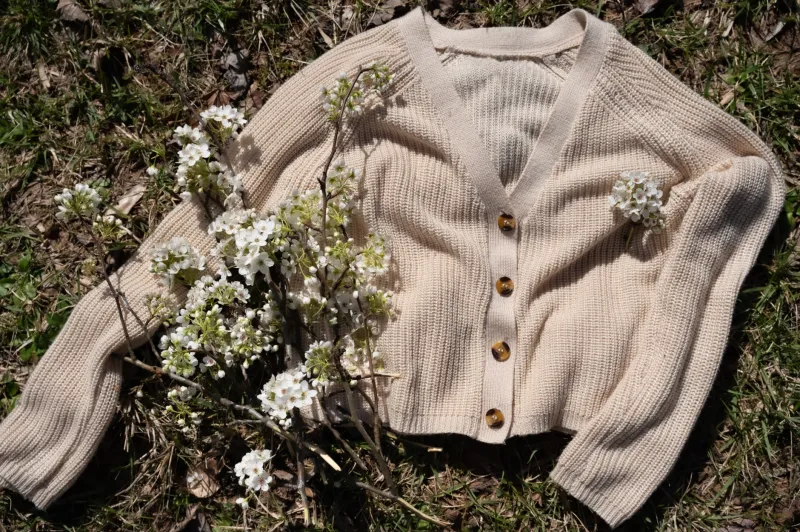
There is a particular sound that tells you a button has come loose in the wash. It is not dramatic. It is a faint click against the drum, easy to mistake for a zip pull or a coin, and by the time you have identified it the button is already halfway to the filter. Most of us find out at the other end, standing over a basket of damp knitwear with one lonely button in our palm and a cardigan that now looks faintly embarrassed.
The good news is that this is almost entirely preventable, and it does not require a sewing machine, a spare afternoon or any particular skill. It requires about five minutes, once per wash load, performed at the point where you are already standing anyway. Think of it as an MOT for your buttons — brief, unglamorous and quietly effective.
Why wash day does the damage
A button under normal wear is mostly sitting still. It might pass through a buttonhole a few dozen times a day, which is gentle work. In a washing machine it is subjected to a sustained battering: water weight dragging at the fabric, the drum turning, other garments snagging, and a spin cycle that flings everything outward with considerable force.
The weak point is never the button itself. It is the thread. Cotton and polyester thread abrade, and a shank button hanging on two remaining strands will happily survive another six months of wearing and fail in the first ten minutes of a hot wash. Add a tumble dryer and you have a machine whose entire purpose appears to be redistributing small objects.
There is also the friction problem. A cardigan washed alongside a garment with a zip or a hook-and-eye is effectively being sanded. Buttons on the outside of a knitted piece take the brunt of it.
The wiggle test: sixty seconds, no equipment
Before anything goes in the drum, hold each button between thumb and forefinger and give it a small, firm twist and rock. Not a violent tug — you are not trying to test it to destruction — just enough to feel whether it moves independently of the fabric.
A sound button is solid. A button that rotates slightly, or that you can feel lift at one edge, has already lost most of its stitching and is simply waiting for the right spin speed. Set it aside. It goes in the mending pile, not the machine.
Run your thumb along the thread on the reverse side too, if you can reach it. Frayed or fuzzy thread is a warning. So is a shank button that flops rather than standing upright when the garment is flat.
Sixty seconds per garment, and you will catch the vast majority of failures before they become losses.
A two-minute repair, done properly
If a button is loose but the thread is intact, you can usually rescue it in the time it takes to boil the kettle. Turn the garment inside out, secure the existing thread with a small knot rather than relying on the old one, then add four or five stitches through the existing holes, matching the original thread colour as closely as your tin allows.
A useful trick for flat buttons on knitwear: sew over a matchstick or a small pin, then remove it, leaving a short thread shank underneath. That tiny gap lets the button sit above the fabric rather than crushing it, and it reduces the strain on the stitches every time the cardigan is fastened. Shank buttons already have that clearance built in, so simply reattach them firmly at the shank rather than through the button face.
If the thread is genuinely past it, treat the button to a fresh start. Two strands of good-quality polyester thread, doubled and knotted at the back, will outlast the garment.
Bag it, turn it, cool it
Once the buttons are sound, the wash itself does the rest of the work.
- Turn knitwear inside out. This protects the button faces from abrasion and stops them catching on other garments.
- Use a mesh laundry bag for anything with small, decorative or vintage buttons. A fine-weave bag will contain a button if it does come off, which turns a disaster into a minor inconvenience.
- Fasten what can be fastened. Doing up the buttons on a cardigan keeps the fronts from twisting and reduces strain on the stitching.
- Wash cool. Thirty degrees is plenty for most knitwear and woollens, and lower temperatures are gentler on thread as well as fibre.
- Keep the spin sensible. A high spin on a heavy wet cardigan puts real load through every button.
- Skip the dryer. Dry knitwear flat, reshaped, away from direct heat. Tumble drying is where most surviving buttons finally give up.
Wash button-heavy pieces with like-minded laundry where you can. A cardigan in with towels is a cardigan in a fight.
When a button does vanish
It happens even to the careful. Before you mourn, check the obvious hiding places. Buttons routinely end up trapped in a hem, inside a lining, in the corner of a pocket, or caught in the door seal of the machine. A torch and a quick feel around the rubber gasket of the washing machine door is worth the effort. So is the filter, if your machine has an accessible one — you would be surprised how many buttons live down there.
If the button is genuinely gone, replace the lot rather than the one. Mismatched buttons on a cardigan are noticeable in a way that a fresh set never is, and it is a good excuse to spend a pleasant half hour choosing something lovely. Keep the survivors in the tin; they will find a use.
Make the habit stick
Five minutes is only useful if it actually happens. The trick is to attach it to something you already do — the moment the basket is emptied, or when you are sorting lights from darks. Keep a small tin by the machine with a needle, a few metres of neutral thread, a pair of snips and a mesh bag. Friction is the enemy of good habits, and a repair kit two rooms away is friction.
For small makers and anyone washing samples, stock garments or market pieces, this check is worth building into the routine too. A cardigan that arrives at a stall with a wobbly button undoes a great deal of careful work. Five minutes at the machine protects the making as much as the garment.
Cardigans do not usually wear out. They are lost, one button at a time, to a drum that does not care. The wiggle test costs you a minute, and it buys you winters.