Honest Light, Clear Detail: Photographing Buttons That Sell Themselves
Daylight is your best employee
Button photography is not about making a button look better than it is. It is about making it look like itself. The buyer cannot pick it up, turn it over, or hold it against a sleeve. Your photographs have to do that work. Start with daylight. A north-facing window on a bright but overcast day is ideal: soft, even, and free from the yellow cast of indoor bulbs. Avoid direct sun, which creates hard shadows and blows out pale bone and cream. A sheet of white card on the opposite side will bounce a little light back into the shank and rim.
Use a plain background. White, pale grey or a mid-grey card works well. A white background can make bone buttons disappear, so keep a mid-grey card nearby for pale sets. If you sell on a marketplace, check the background rules; some prefer white. Set your camera or phone to a neutral white balance and avoid filters. The buyer needs to see the true colour.
Give the eye a ruler, not a guess
Size is the most common source of disappointment. A button that looks 20mm online and arrives at 12mm is a return waiting to happen. Put a small ruler in one photograph, with the millimetres visible. If you use a coin, say which coin and remember that coins vary; a ruler is clearer. List the size in millimetres and, if you know it, the ligne. Use the same scale reference across the set so buyers can compare.
Show the back, the shank and the honest wear
A button is not just a front. Turn it over. Show the back, the shank, the holes, and the rim. If it is a shank button, photograph it side-on so the shank depth is clear. If it has a metal loop or a plastic anchor, show that too. This is where honest wear lives: scratches, tarnish, chips, hairline cracks, and the little marks that tell a buyer it is old. Do not hide them. Describe them. A clear photograph of a small chip builds more trust than a soft-focus image that pretends it is not there.
Group sets without hiding the odd one out
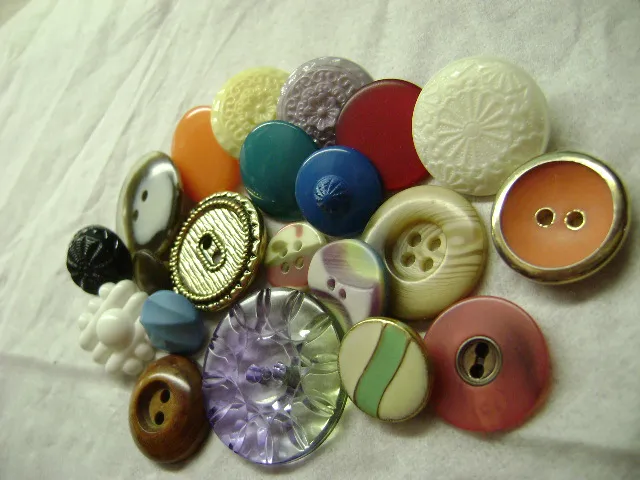
If you are selling a set, show the whole group first, laid out flat with space between the buttons. Then show a close-up of one or two representative buttons. If one button is different, show it clearly and say so. Do not stack buttons in a pile; the buyer cannot count them or see the variation. Arrange them in a grid or a loose line. Keep the light even across the group. For sets with mixed sizes, put the ruler beside the smallest and largest.
Describe size and condition in plain English
Write the size in millimetres, the material if you know it, the colour, and the condition. Avoid vague words like vintage unless you also say what that means. A useful formula is: size, material, colour, holes or shank, condition. For example: 15mm two-hole, navy blue plastic, matt finish, good used condition with light surface wear and one small rim chip shown in photo four. That is honest, specific, and easy to compare.
Present the lot as it will arrive
The final photograph should show what the buyer will actually receive. Lay out every button in the lot, including the spares. If the listing includes a tin or a card, show it. If the buttons will be posted in a small bag, say so. Buyers trust sellers who show the whole parcel, not just the prettiest button. Use natural light for the packing photo too, so the colours stay true.
A simple listing routine
Choose a window. Set out a white card and a mid-grey card. Photograph the front, the back, the side, and the group. Add the ruler. Check the images on your phone at full size before you upload. If the colour looks wrong, adjust the white balance rather than the saturation. Write the description from the photographs, not from memory. Then pack the lot and take one last photo of the contents. It takes twenty minutes and saves a dozen messages.
ButtonBox Supplies sells to makers and small businesses, and we know how much a clear photograph matters. A good button portrait is not a gloss. It is a fair introduction. Show the ordinary truth, and the right buyer will recognise it.