The Quiet Workhorses: Why Plain Buttons Earn Their Keep
Photo: U.S. Navy photo by Petty Officer 2nd Class Grace Youngstrom, Public domain, via Wikimedia Commons
The romance of the unremarkable
Every sewing box has its stars. The hand-painted ceramic button. The carved corozo disc with the grain running through it. The little glass sparkler found at a fair. They are lovely, and they deserve their place. But there is another kind of button that never makes it into the photographs: 15mm across, two holes, navy, grey or bone. It is not shaped like a leaf. It does not start conversations. And yet, if you sew clothes that actually get worn, it may be the most useful thing in your stash.
At ButtonBox Supplies we sell plenty of characterful fastenings, and we enjoy them. But we also believe the plain workhorse button deserves a proper defence. The case is simple: most garments are not statements. They are Tuesday. They are the school run, the supermarket, the third wear before laundry. A cardigan that has to survive a winter term does not need a button that catches on a seatbelt or demands careful hand-washing. It needs a fastening that matches the cloth, sits flat, and can be replaced without a search party.
What dull actually means
When we say dull, we mean ordinary in the best sense. A two-hole button in a solid colour, with a slight rim and a smooth back. No shank to crush, no fragile imitation pearl, no novelty shape that makes buttoning a faff. The 15mm size is a useful middle ground: big enough to handle, small enough for shirt cuffs and lightweight knits. Navy covers dark denim, chambray, wool and most navy things. Grey is the peacekeeper for striped jersey and charcoal. Bone disappears into cream, oat and natural linen.
These buttons are not invisible. They are quiet. There is a difference. A bone button on a cream shirt still reads as a fastening; it simply lets the cloth do the talking. And because they are inexpensive, you can afford to treat them as a working material rather than a precious find.
Buy by the handful, not the one-off
The single biggest mistake in a working stash is buying one button for one project. It feels sensible at the time. Then the button is lost, or the garment needs a spare, or you find a second cardigan that needs the same treatment. Buying in multiples is not hoarding; it is maintenance. A card of six, twelve or twenty-four plain buttons costs very little and saves a future trip.
Think in threes: one to sew, one for the spare envelope, and one for the inevitable repair. If you are making a small run for a shop or market, buy enough for the whole run plus ten per cent. Dye lots can vary, and a plain button is only useful if it matches its siblings. At ButtonBox Supplies we like to keep a small stock of these workhorses by size and shade, not by project. That way, when a garment arrives on the mending pile, you are not starting from scratch.
A small drawer, organised by shade and size
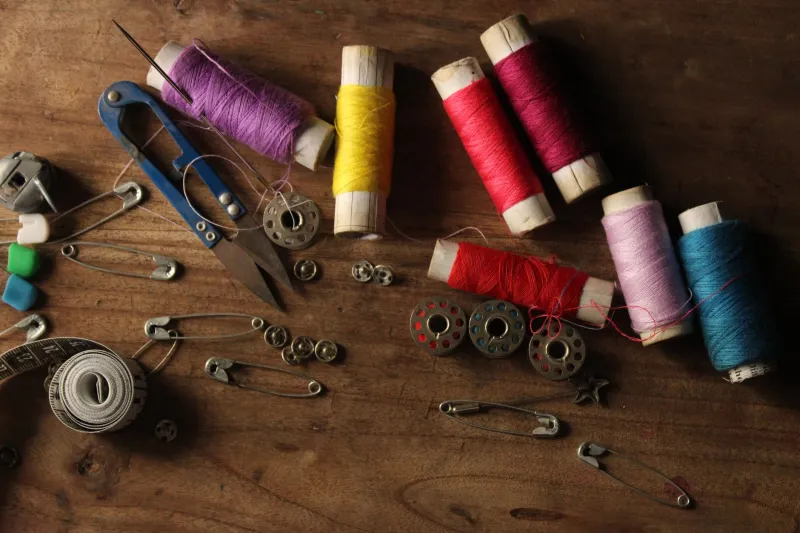
You do not need a museum. A divided box with a few compartments is enough. Keep 12mm to 15mm two-hole buttons in one section, 18mm to 20mm in another, and put navy, grey and bone at the front. Label the compartments with size in millimetres rather than vague words. Add a tiny needle book and a spool of matching thread in navy and grey. The point is not perfect organisation. The point is that a repair takes five minutes, not an afternoon.
This is also a quiet act of sustainability. A button that can be replaced from stock keeps a cardigan in wear for another winter. A garment that gets worn is a garment that does not need replacing. The plain button is not glamorous, but it is a small part of a slower, more practical wardrobe.
When novelty has its place
None of this is an argument against beautiful buttons. A hand-painted ceramic button can lift a coat. A carved corozo button can be the whole point of a knit. Novelty buttons are brilliant for gifts, children's clothes, and projects where the fastening is part of the design. The trouble starts when every project demands a star. Sometimes a garment simply needs to be worn, not admired from a distance.
So keep a line between your statement buttons and your workhorses. Use the good ones deliberately. Let the plain ones do the daily work. That is not dullness. That is a sewing box with a sense of proportion. At ButtonBox Supplies, we are happy to sell you both. But if you are building a stash from scratch, start with the quiet ones. They will earn their keep long after the novelty has gone back into the tin.