Softly Does It: A Comfort-First Guide to Gentle Fastenings

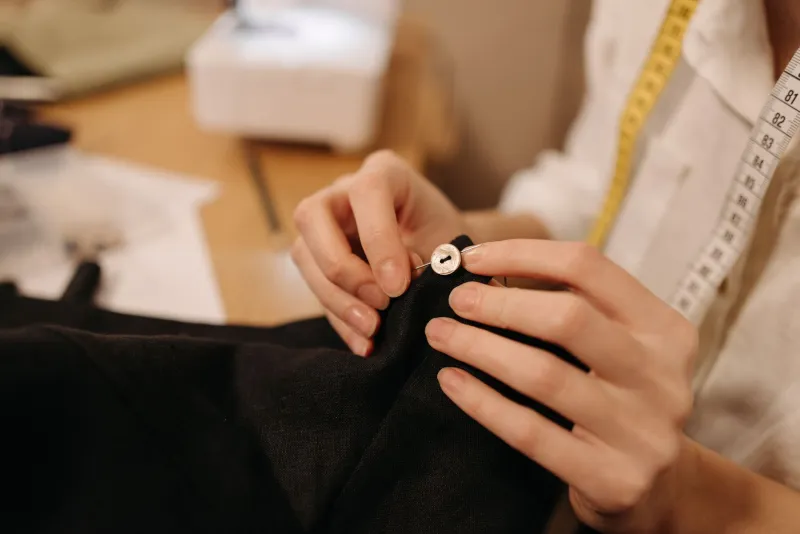
Photo: close-up smooth resin buttons on soft cotton fabric with sewing box and natural light, via static0.cbrimages.com
Not every button problem is about holding power. Sometimes it is about the way a fastening greets the skin: the cold shock of a metal shank at the wrist, the scratch of a raised rim at the back of the neck, or the fiddly business of pushing a small button through a tight hole when fingers are tired or sensory overload is already close. For some wearers, a button is not a decorative detail. It is the part of the garment they notice all day.
This is not about making every project look medical or plain. It is about treating comfort as part of the design brief, alongside fabric, fit and finish. A gentle fastening can still be charming. It can still be beautiful. It simply has to be kind.
Start with the wearer, not the button
Before you fall for a card of spotted ceramic buttons, ask where the fastening will sit. A button at the back of a collar has a very different job from one at a cardigan front or a cuff. Sensitive skin often complains most at the nape, the inner wrist, the waistband and anywhere a seam already rests. If the wearer uses a wheelchair, carries a backpack or spends the day at a desk, pressure points matter too.
It also helps to ask what the wearer finds difficult, rather than guessing. Some people dislike anything cold. Some dislike raised bumps. Others find small buttons hard to grasp, or the noise of a press stud startling. A quick conversation before cutting and stitching saves a great deal of unpicking later.
Smooth rims, quiet edges
Run a fingertip around the rim of any button before it goes near a garment. A good button should feel smooth and slightly rounded, with no sharp moulding seam, burr or chipped coating. Domed resin, polished corozo and well-finished mother of pearl can all feel gentle. Matte finishes are often softer to the touch than high-shine metal, though the shape matters more than the shine.
Avoid buttons with decorative points, rough engraving or a pronounced lip on the reverse. If you are buying online, look for close-up photographs of the back as well as the front. A pretty face is no comfort if the underside feels like a tiny cog.
Flat backs and shanks: where the bulk sits
A flat two-hole or four-hole button sits close to the fabric, which can feel neat and unobtrusive. The catch is the thread bundle underneath. On thin or sensitive-skin garments, a tall knot and a thick thread shank can create a hard little pebble against the body. You can reduce this with a backing button, a flatter knot placement and a small square of soft interfacing behind the fastening.
Shank buttons lift the button away from the cloth, which is useful on thick wool, knitwear and coats. The shank itself, however, can press into the wearer if it sits against the skin. Where possible, place shank buttons on a placket, facing or lined area so the shank is cushioned by fabric rather than resting directly on the body. If the design allows, choose a short shank rather than a long one.
Metal, nickel and the great unknown
Metal buttons can be sturdy and handsome, but not all metals suit all wearers. If someone has reacted to cheap jewellery or belt buckles before, be cautious with unknown metal alloys. Look for nickel-free descriptions, coated brass, stainless steel or good-quality resin alternatives. A chipped coating is a warning sign: once the surface breaks down, the metal underneath may become more noticeable against skin.
This is not a medical guide, and reactions vary enormously. If the wearer has a diagnosed skin condition, a known metal allergy or an implanted medical device, take advice from their clinician or allergy specialist before choosing metal or magnetic closures. For everyday making, a fabric barrier between button and skin is a sensible, low-drama precaution: a facing, a lining, a patch of soft cotton or a backing button can all help.
Covered buttons and fabric-friendly faces
Fabric-covered buttons are a lovely option for sensitive-skin projects because the face can be made from the same soft cotton, linen or lightweight wool as the garment. Choose a self-cover kit with a smooth plastic back, and check that the back does not have rough prongs or a sharp rim. When covering, keep the fabric smooth and free from bulky seams at the edge, and trim the back neatly.
Covered buttons are not automatically soft, though. The tension of the cover can create a firm dome, and the back can still be hard. Use them where the reverse is protected by a placket or lining, and test the finished button against your inner wrist before committing. If you want a softer feel, a fabric loop and a flat covered button can be gentler than a button pushed through a tight buttonhole.
Alternatives worth keeping in the notions box
Sometimes the kindest fastening is not a button at all. Soft fabric loops, rouleau loops and ties distribute pressure differently and are easy for helpers to manage. Press studs can be neat, but some wearers find the cold metal and the snap unsettling; covered snaps or plastic snaps may suit better. Toggles and duffle-style fastenings can be easy to grip, though they need a soft backing so the bar does not dig in.
Magnetic closures are popular for bags and adapted clothing, but they deserve careful thought. They can be surprisingly strong, they may interfere with medical devices, and they can snap shut on fingers. Use them only with the wearer's agreement and medical advice where relevant. For children or people with limited hand strength, a large, smooth button with a loose fabric loop is often more comfortable and more dignified than a tiny button and a tight hole.
Four simple tests before you finish
First, do the thumb sweep. Run your thumb over both faces of every button and along every rim. If you feel a sharp edge, change the button or smooth it if the material allows.
Second, do the wrist rub. Place the button against the inside of your wrist and press gently. Your wrist is far more sensitive than your fingertips, so it will tell you things your hands miss.
Third, make a fabric sandwich. Lay the button between two scraps of the garment fabric, press down and move it slightly. Does the hard shape telegraph through? If so, add a backing button, interfacing or a soft barrier layer.
Fourth, wear a sample. Stitch the closure to a small band of fabric and wear it against the skin for twenty minutes while you get on with something else. This is not a clinical test, just a maker's reality check. If it niggles, it will probably niggle more by teatime.
Finishing details that make the difference
A backing button is one of the quiet heroes of comfort sewing. It gives the thread something to pull against and keeps the knot away from skin. Bury thread tails between layers, use a soft cotton thread rather than a stiff bulky one, and avoid long floats or loose loops that can catch. On the inside of the garment, a strip of lightweight interfacing can stop the button pulling through the weave and create a smoother surface.
Above all, remember that comfort is not an afterthought. It is part of the make. A gentle fastening does not have to be invisible or dull; it simply has to respect the person who will wear it. Choose smooth edges, protect the back, consider the metal and test before the final stitch. Then the button can do what it does best: close the garment quietly and let the wearer forget about it.