Branch Line to Button Town: A Rail Weekend for Notions Nerds
There is a particular pleasure in arriving somewhere by train with nothing but a small bag and a shopping list. No parking to negotiate, no boot to fill, no reason to hurry past the interesting bits. For anyone who collects buttons, that rhythm suits the hobby down to the ground. Buttons are small, light and easy to carry, and the towns that made them were nearly all built around stations in the first place.
So here is a gentle itinerary — part day out, part weekend — for the fastening-inclined traveller. It is not a checklist to be completed at speed. It is a shape for a couple of days, with room to stand in front of a tray of horn buttons for twenty minutes if the mood takes you.
Why go by train, and why these towns
Britain's button and trimming trades grew up in manufacturing towns, and manufacturing towns grew up around canals and railways. That means the heritage is unusually easy to reach on foot from a platform. You can step off at a city-centre station and be rummaging through an antique centre within ten minutes.
Trains also solve the awkward question of how much you're allowed to bring home. A weekend bag with a zip pouch of buttons in it weighs almost nothing, and nobody at the barrier is going to raise an eyebrow. Do check timetables before you commit, mind — Sunday services in particular thin out considerably outside the big cities, and museum opening hours shift with the seasons.
Stop one: Birmingham, where the small metal things were made
The Jewellery Quarter is the obvious starting point, and it earns the fuss. In the nineteenth and twentieth centuries this tight grid of streets turned out buttons, buckles, chains, badges and every other small shiny object a growing empire could want. The Museum of the Jewellery Quarter on Vyse Street preserves a workshop that closed more or less as it stood, tools and all — a fascinating look at how much handwork sat behind a single finished piece.
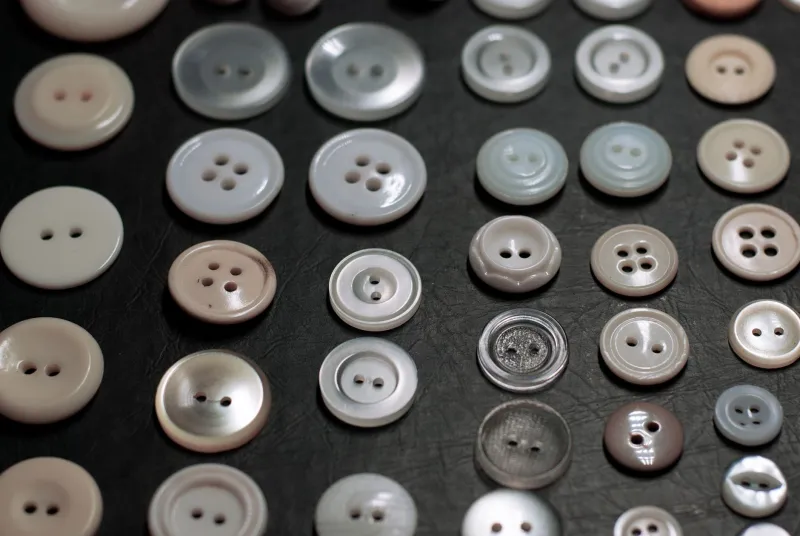
Give yourself a slow hour there, then walk. The quarter is full of antique centres and small dealers, and the display cases toward the back of these places are where the button trays tend to live. Ask at the counter; stock is often kept in boxes rather than laid out. On market days, Birmingham's indoor markets are worth a wander for fabric, trimming and the occasional lucky bag of mixed fastenings.
Stop two: Coventry, where the ribbon came first
Coventry's weaving trade is the lesser-known half of the button story. Ribbon, tape and narrow trimmings fed the same sewing boxes that buttons ended up in, and the city's museum collections hold a good deal of that history. It's the sort of place to visit with a project in mind: a cluster of covered buttons wants matching ribbon, and a ribbon-weaving town is the place to buy it.
Coventry also rewards the aimless browser. The city centre has been rebuilt more than once, but the market and the surrounding streets still throw up the odd haberdashery stall, and a rummage here is cheap entertainment on a wet Saturday.
Stop three: Macclesfield and the silk-covered button
If you like your buttons soft rather than shiny, head for the silk town. Macclesfield's mills once supplied fine silk for everything from linings to passementerie, and silk-covered buttons were among the small, precise things that came out of that trade. The Silk Museum and the adjoining mill give you the full picture — looms, patterns, the whole chain from cocoon to finished cloth.
It's a quieter day out than Birmingham, and better for it. Bring a notebook. You will find yourself sketching button clusters you have no immediate use for.
Where the vintage stock actually is
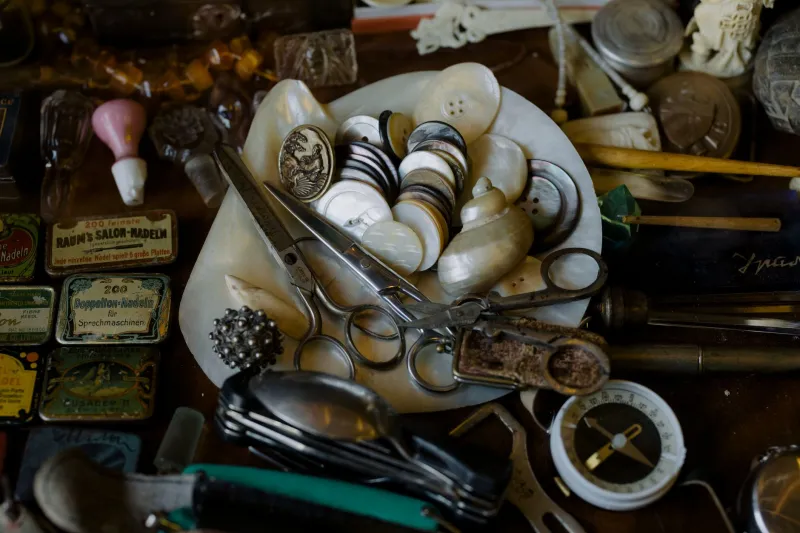
A short and slightly unglamorous truth: the best button hunting rarely happens in designated button shops. It happens in charity shops on the edge of prosperous suburbs, in antique centres with a cabinet of sewing oddities, at church-hall sales, and in the dusty back corner of a haberdasher that has been there since before you were born.
Be the customer who asks. "Have you anything older out the back?" is a perfectly good opening line, and small shopkeepers generally enjoy being asked about the strange stock they've been meaning to sort through.
Being a good visitor, and a good customer
Buy something small everywhere you browse, even if it's a card of ordinary shirt buttons you could get anywhere. Independent notions shops survive on the assumption that browsers sometimes become buyers. Don't haggle over a three-pound card of buttons; do ask before photographing anyone's stock, and do leave your details if a shop mentions a box coming in next week.
And when you get home, write down where things came from. A scrap of paper in the tin — town, shop, price — turns a nice button into a small piece of memory.
A weekend shape that works
Saturday in Birmingham, arriving mid-morning and leaving late afternoon, with a proper lunch somewhere off the main drag. Sunday in Coventry if you want an easy, compact day, or Macclesfield if you'd rather have a longer ride and a slower afternoon. If you're doing all three, book two nights and accept that the third will be a half-day.
Pack a small tin or a zip pouch for fragile pieces, a soft tape measure for checking sizes, and a tote for anything boxed. Wear the coat with the big pockets. Buy an Advance fare if you can commit to a train, and remember that a railcard pays for itself surprisingly quickly once you've done two of these trips.
Then come home, spread the haul across the table, and start the good part: deciding what each one is for.