The Patient Button: Following a British-Made Fastening from Bench to Sewing Box

Photo: Jaggery , CC BY-SA 2.0, via Wikimedia Commons
There is a particular sound a good button makes when you drop it onto a wooden table. Not a clatter, exactly. More of a small, satisfied tap. It is the sound of something with a bit of substance to it, and it is usually the last thing you notice after you have already admired the colour and turned it over in your palm.
Most of us meet buttons at the end of their journey — in a shop jar, a market stall, or a biscuit tin inherited from a aunt. But a British-made button has a life before the sewing box, and it is worth knowing what happens in that stretch between raw material and polished finish. Not because every button needs a backstory, but because the difference between a fastening that lasts and one that quietly gives up is often made in the small, unglamorous steps.
It Begins With a Refusal
Ask a UK button manufacturer what they look for in a raw material and the answer is rarely dramatic. Consistency, mostly. Colour that will not sulk after a winter of wear. Hardness that holds a shape without becoming brittle. The ability to take a polish without turning greasy or chalky in the hand.
British makers work with a familiar cast: casein, that old milk-protein standby; corozo, the vegetable ivory from tagua palm; polyester and urea resins; horn, shell, and wood where the batch allows. Each has its own temperament. Casein can be beautifully deep in colour but needs careful drying. Corozo has a grain that shifts under the light. Resin is forgiving but can be dull if the finishing is rushed.
The first quality check is often a refusal. A batch that is slightly off in shade, or that has hidden pits beneath the surface, gets turned away before it ever reaches a lathe. That sounds obvious, but it is the sort of decision that separates a button you keep for twenty years from one you replace twice in a season.
The Slow Bit in the Middle
If there is a single ingredient that marks out a well-made button, it is time. Time in the tumbler. Time at the polishing wheel. Time spent checking that the holes are clean and the rim is smooth.
A cheap button often announces itself at the edges. Run a fingertip around the rim and you may feel a faint ridge, a burr, or a sharpness that will eventually fray thread. Good finishing softens that edge without rounding it away entirely. The holes should feel like little polished tunnels, not rough punch marks. On a shanked button, the shank should sit square and secure, not wobble like a loose tooth.
UK makers tend to be fussy about colour fastness and heat resistance too, which matters more than crafters sometimes realise. A button that fades in a sunny window or softens under an iron is not much use on a favourite cardigan. Small workshops often test in modest batches rather than grand laboratories, but the principle is the same: a button should behave itself in real life, not just look promising under shop lighting.
What the Factory Floor Knows That the Shop Rail Doesn’t
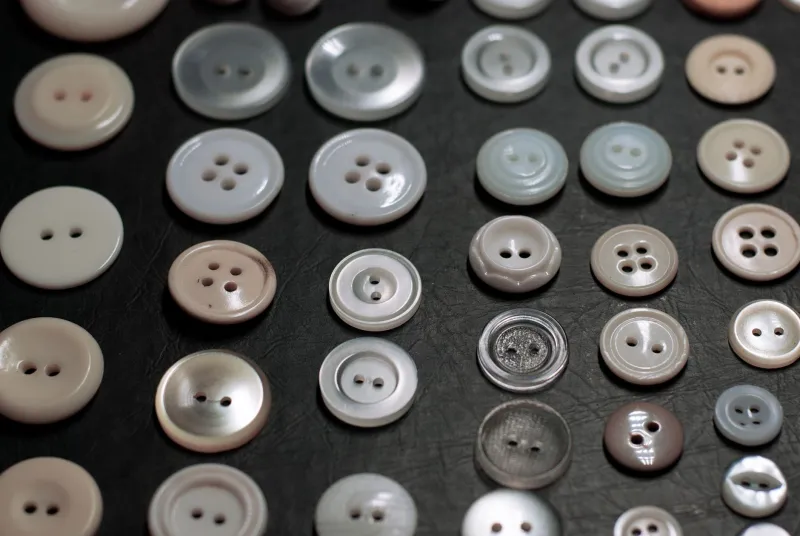
On a shop rail, buttons are usually arranged by colour and size, which is helpful for matching but useless for judging substance. The factory floor would tell you to look at three things first: weight, thickness, and the back.
Weight is not about being heavy for the sake of it. It is about density. A well-made button feels solid in proportion to its size. Thickness should be consistent across the batch — no thin edges on one side and a fat belly on the other. And the back is where shortcuts often show. Look for smooth finishing, clean holes, and a shank that has been properly set rather than hurriedly glued.
Then there is the matter of the mould line. On some resin buttons, a faint seam around the edge is almost inevitable, but it should have been polished back. If it catches your nail, it will catch your thread.
Reading a Button in the Shop
You do not need a workshop to make a decent judgement. Start by turning the button over in your hand and looking along the rim at eye level. A good edge is even, with no obvious flat spots or snags. Run your thumbnail lightly around it. If it feels like a tiny saw, put it back.
Next, thread a spare bit of sewing cotton through the holes in the shop if you can, or at least imagine doing so. Rough holes will shred thread over time, especially on a garment that gets washed often. Check the shank on any button that has one: it should feel firm and centred, not bent to one side.
Finally, tap it gently on the counter. A dull thud is not a disaster, but a bright, clean tap usually suggests a dense material and a proper finish. It is not a scientific test, but it is the same instinct that makes a good button feel right in the hand.
Why Buying British Matters to Small Makers
For a small creative business, the practical reasons often come first. British button makers can usually offer shorter lead times and smaller minimum orders than overseas factories. That means a maker sewing twenty cushions can buy twenty buttons rather than five thousand. It also means conversations. You can ask about a colour, request a sample, or explain that you need something that will survive a hot wash and a tumble dryer.
There is also the repair-and-replace side of things. A UK supplier is more likely to remember a batch, match a shade, or tell you honestly whether a button will still be available next season. For a small maker building a reputation on garments that last, that kind of continuity is worth a great deal.
And then there is the quieter point. Buying British buttons keeps small workshops in business — the sort of places that still tumble a batch for longer than strictly necessary because they know the difference. That is not nostalgia. It is a supply chain with a bit of human judgement left in it.
Bringing It Home
A button’s journey ends in your sewing box, but it does not stop there. It goes onto a coat, through a winter, into a wash, and back out again. The best ones earn a little patina along the way. They lose a fraction of their shine and gain a bit of character.
So next time you tip a new haul into your tin, give one a tap. Listen for that small, solid sound. It is the sound of a button that was not in a hurry — and there is something quietly reassuring about that.